Showing posts with label AAPL. Show all posts

Thursday, February 7, 2013

Is AAPL's Loss GOOG's Gain?

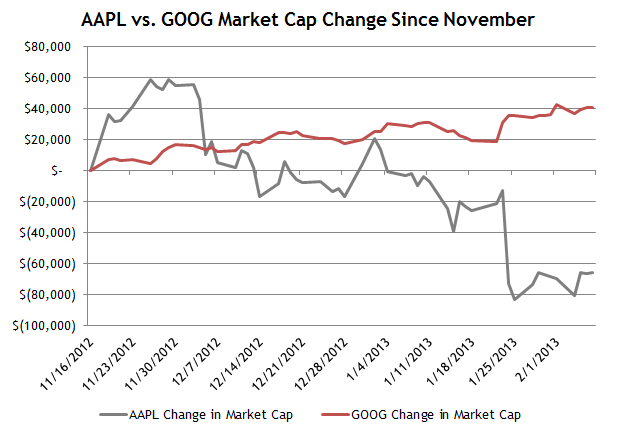
Although GOOG refuses to directly monetize its dominant position in mobile, one might expect that any lost market cap for AAPL might be gobbled up by GOOG because the two are an effective duopoly in smartphone operating systems.  Below is a chart of the change in market cap for AAPL and GOOG since November 16.  Since then GOOG has gained $40B in market cap as AAPL has lost $65B.  

Note: I chose to start the chart on November 16 rather than AAPL's September high because that's when the S&P 500 bottomed after a 5% pullback.  I reasoned that this time period was less influenced by beta.


Thursday, January 24, 2013

Earnings Call Notes 1.24.13

Like most analysts during earnings season I spend a lot of my day reading earnings calls.  I've been trying to figure out a good way to incorporate some of the data that I gather from those calls into the blog.  To that end below are quotes from calls that I've read today--snippets of information that I find relevant (typically on a macro/industry level) from companies that I have some working understanding of.  All the transcripts are found at Seeking Alpha.

Raymond James--RJF (Regional Broker)
"assets under management, have gravitated more towards fixed-income and our retail clients have gravitated more to fixed income as in asset allocation. So with all those factors at play, we're not as sensitive to the U.S. equity markets as we have been in the past."  
"I think that our investors' sentiment and our sentiment -- investor sentiment survey is up. We haven't seen a massive move to equities. I know a lot of the funds are showing big inflows. I think we've been more with our investors, we try to keep them engaged, maybe they've been a little more engaged in other places. So I haven't seen a big movement yet. But having said that, the commission levels in January have been pretty good so far. I'm a little bit behind in terms probably up to today. But I mean, I can't say we've seen a huge flood into equity since the beginning of the year. "
McCormic--MKC (Spices)
"Globally, digital marketing was 12% of our total spending, up from 5% in 2010." 
"Our brand marketing plans include further increases in digital marketing, support for new product launches and a sharp focus on retail price points. " 
"Sandy. While this devastating storm had a limited impact on our sales to customers in the Northeast, it did impact a number of suppliers in this area, which created product shortages during our critical holiday selling period. We also lost several ships of production time in our manufacturing distribution facilities in Maryland." 
"we've had about a 45% increase in commodity cost over the last 4 years and have taken about 25% pricing and we've taken a number of different actions along the way, and we are always evaluating the impact of that on volume….and by the way, what we have seen as our pricing has gone up, we have seen those price gaps close now as competition, largely private label, has also taken place increases to either catch up or improve their margins." 
"About quick service restaurants: I'm following our customers' releases as closely as -- probably closer than you are because they really impact us. But I would say that we think that it's going to be fairly challenged."  
"[around the holidays] typically we do see an increase in branded shares for a couple of reasons. One is consumers are less willing to take chances on their meals." 
Logitech--LOGI (Consumer Electronics/Peripherals) 
"As we discussed in our Q2 earnings call the main factor in our weak performance was a significant weakness in the global market for new PCs. This weakness which had a negative impact on sales in all our PC related categories reflects the combination of the slow transition to Windows 8 and the growing popularity of tablets and smartphones as mobile computing devices."
Hill Rom--HRC (Healthcare, Hospital Beds)
"Our rental business in North America remains challenging due to continued efforts by hospitals to reduce their operating and supply chain costs. We expect this to continue given the economic pressures they are dealing with. "
Nokia--NOK (Cell Phones)
"we shipped 6.6 million Smart Devices units of which 4.4 million were Lumia devices." 
"Now more than ever, operators are pushing for a third ecosystem to emerge, and they are committing to more marketing, more training, and more in-store displays to help Windows Phone and Lumia to grow." 
Grainger--GWW (General Business Supplies Distribution)
"Light Manufacturing was up in the high-single digits; Heavy Manufacturing and Commercial were up in the mid-single digits; Government and Retail were up in the low-single digits; Reseller was flat; Contractor was down in the low-single digits; and Natural Resources was down in the mid-single digits." 
Symantec--SYMC (Cyber security. Lots of interesting discussion. Worth doing a full read through)
"welcome to the unveiling of Symantec 4.0"  
"despite the fact that we have such great point solutions built mostly from acquisition…We haven't really integrated the value of these different point solutions" 
"the porous nature by which information is flowing across enterprise, individuals, governments and your personal world. Those boundaries are now taken down." 
"There was one large pharmaceutical company, and as the CIO was describing his real estate he said, look, we have 60,000 PCs. We have about 7,000 Macs. We have 15,000 iPads and over 10,000 Android smartphones in their environment that he was aware of. And he said what he needs is an offering that allows him to let people use those devices but, at the same time, protect the business. " 
"while we had the great assets, we didn't have a strategy or an operational plan to focus on delivering value for customers, and that's what Symantec 4.0 is all about." 
Western Digital--WDC (Hard Drives)
"there are early indications of consumers' stronger intentions to purchase new PCs this year."  
"The HDD market shipped approximately 136 million units during the December quarter, slightly less than the 140 million units we anticipated in our guidance." 
Apple--AAPL (Fruit company?)
"Apple is in one of the most prolific periods of innovation of new products in its history." 
"We have now sold well over 0.5 billion iOS devices" 
"The pipeline is chock-full, I don’t want to comment about a specific product, but we feel great about what we have got in store."
Netflix--NFLX (Pay TV Channel which happens to be distributed via internet)
"Both the rise of tablet phones and the rise of smart TVs are very helpful to us, and they are really the beginning of a trend along Internet connected ecosystem devices. And certainly the more convenient those devices get, the more people will feel comfortable watching and enjoying content on a wide range of devices, some day including Google Glasses, Internet Watches all kinds of scenarios over the next five years and as well as multi-screen scenarios, where you use your tablet or phone to chose content on the TV. "
US Airways--LCC (Airline)
"several years ago, we started talking about all the things the industry needed starting with consolidation. Included on that list was management teams that care more about returns than market share. Included on that list was a better management that work better with labor. And I think all those things, we've made huge progress on. Also on that list, though, was a better understanding by the government of the importance of aviation and a national policy from a national aviation policy from the government, and that hasn't happened. And that's next on the list, and that's where the rest of the value, I think, is going to come from, Jamie, and where it needs to come from. We've got -- everything I've talked about so far is self-help, and the industry had to do a lot of this to get itself right, and I think we've made huge progress in that regard. But we're fighting our own government on a lot of issues, and taxation is high on the list, but there are other issues. Other international carriers don't fight the same battles we do, and we're -- well, the playing field's not particularly leveled."

Putting Apple's Decline in Perspective

Apple's 10% decline today represents a $45B loss of market value, which is a larger amount than the market cap of 85% of the companies that make up the S&P 500.  $45B is roughly equivalent to the market value of COST, NKE or MDT.

Since its peak at $659B in September AAPL has lost $230B worth of value.  That's more than the market cap of all but seven US companies, nearly equal to the entire value of MSFT, CVX and GE!

In fact, AAPL's loss in market value has been so large so fast that it is entering the realm of macroeconomic proportions.  Since September, AAPL's market cap decline has been almost equal to the amount of money that the Fed has injected into the economy via QE3, which sits at ~$250B.

Comparing Apple's decline to QE3
QE3 measured as increase in MBS/Treasuries at Fed plus commitments to buy MBS

Tuesday, January 15, 2013

The Pace of Apple's Decline Compared to the S&P's '08 Crash

On the way up, people would talk about AAPL as its own asset class because of how well it used to trade relative to the S&P 500.  Now on the way down, AAPL has remained relatively uncorrelated to the index, but not in a way that most people want to see.  Apple is now down almost 30% from its peak levels hit in September of last year.  Such a steep fall would certainly be considered a crash for any other asset class.

In fact, AAPL's recent decline has paced the 2008 September-March crash quite well.  If AAPL were to continue to pace the decline it would bottom somewhere around $350.


Monday, January 14, 2013

A Past Time of Uncertainty for Apple

It looks like Apple is set to have another rough day today as the Wall Street Journal reported that the company has cut orders for iPhone components on weak sales.  Apple shareholders are rightly worried, but perhaps can take some solace in another time that investors were skeptical and the company ended up prevailing:

It's easy to forget that for almost a year after the iPhone was initially released it actually looked like Blackberry would dominate the mobile phone market.  Recall that the original iPhone didn't have any third party apps, and the app store didn't open until a year after the first iPhone was released.  During this pre-app period there were real concerns that consumers wouldn't adopt a touch screen and that functions like BBM would draw consumers to Blackberries.  In the year after iPhone's release RIMM outperformed AAPL by as much as 75%.  Once the app store was launched all of that changed though and over time of course the iPhone became dominant.

All this is not to say that Apple shareholders are in the clear, but at least to point out that there has been skepticism about the company's operational abilities before and everything turned out alright.

AAPL vs. RIMM Performance From iPhone's 2007 Release to App Store Launch in 2008


Monday, December 17, 2012

What Does it Say That Samsung and Apple Have Roughly the Same Multiple?

It seems interesting that according to data pulled from Bloomberg's site Apple and Samsung are trading at virtually the same earnings multiple.  One would think that if Apple is losing share to Samsung then Samsung would have a higher multiple.  Samsung has been advancing as Apple has declined, but given the low multiples across large cap tech, does Apple's decline say more about the company or the industry?


Tuesday, December 11, 2012

Is Tax Selling Causing Apple's Decline?

In recent weeks, there has been talk that part of Apple's 23% decline may be due to the fact that capital gains taxes are likely to go up in 2013.  The logic goes that since many Apple shareholders are sitting on large capital gains, they are selling to lock in a lower tax rate.  If that logic were true one would expect to see similar selling in other top performing stocks, but on average other top long term holds have not seen the same decline that Apple has.

In October I posted a list of the top performing stocks since October 2007--stocks which should have large embedded capital gains liabilities.  The chart below compares their performance since the election.  It turns out that on average these stocks have continued to do better than the S&P 500 since November 6.  This basket has outperformed the S&P by 2.8% since then.

Capital Gains Effect on Stock Selling


Wednesday, December 5, 2012

After an Iconic CEO Leaves

Since Apple is having a particularly rough day today, I thought it would be worth reposting something I initially posted in August 2011 when Steve Jobs officially stepped down as CEO.  It's a comparison of DIS, WMT and MSFT after their iconic CEOs departed.  Looking at DIS and WMT, each of those companies continued to be top stocks for 5-6 more years.  MSFT underperformed the S&P but greatly outperformed the Nasdaq after Gates left.  Can AAPL's outperformance last as long?  It's gone about a year and a quarter without Jobs and until recently has remained a strong stock, but perhaps tech is such a rapidly changing space that the benefit of Jobs' vision has less longevity.

--

Originally posted 8/25/11:

With Steve Jobs stepping down at Apple, there are plenty of questions about what comes next.  Jobs is undisputedly the most influential CEO of the last decade and one of the most influential people of the last 35 years.  Jobs' contributions to society have been extraordinary and today he is deservedly drawing comparisons to other great industrialists like Ford, Edison, Carnegie and Rockefeller.  When the history books are written, it's likely that these comparisons will hold up.

While I wanted to run a stock chart comparison to these early 19th century industrialists, individual stock data from the early 20th century isn't easy to come by.  Still, there are at least three iconic CEOs of the latter 20th century who can arguably be compared to Jobs: Disney, Walton and Gates.  Here's a look at how each company's stock performed in the decade following its CEO's departure.

Each chart begins on the date that the CEO stepped down.

DIS

Click to Enlarge

WMT


MSFT


What's striking is that in the case of DIS and WMT, each stock continued to massively outperform the S&P 500 for 6 and 5 years respectively after the departure Disney and Walton.  Perhaps this is a testament to the bench of talent that a great CEO cultivates.  However, after the 5-6 year mark, both stocks had prolonged periods of underperformance (for DIS at least partially due to the 1974 bear market).  This may be an indication that a visionary CEO can continue to carry a company for years after leaving, but after a while, the company loses the benefit of that vision.

Of the three companies, only MSFT has underperformed the S&P 500 from the day that Gates stepped down.  Of course at least part of this has been because of the collapse of the tech bubble (MSFT was trading at about 60x earnings at the time).  Still, looking at the underlying earnings of MSFT and the gross mismanagement since Gates left, it is a testament to Gates' leadership that the company continues to enjoy top market share in the PC business.  

Another primary reason for MSFT's poor performance has been because of the efforts of Jobs himself who arguably engineered an organic monopoly in high end consumer electronics.   He will be missed for his vision, but we may not really know how much we miss him for another 5 years.

Friday, October 26, 2012

How Many Words Does it Take to Describe a Business?

After AMZN's report last night and surprisingly positive stock reaction, I decided to turn to the annual report for some perspective.  I was stunned by how little information the company actually provides to its shareholders.

The entire description of AMZN's business is only 1000 words--3 pages.  Amazon web services is described in one sentence: "We serve developers and enterprises of all sizes through Amazon Web Services (“AWS”), which provides access to technology infrastructure that enables virtually any type of business."  Rackspace takes 3700 words to describe a similar business line.

For a sense of how out of the ordinary AMZN's bare bones description is, below is a list of the number of words it takes other large tech, internet and retail companies to describe their business lines.  Most are about 4x as long.  Length does not necessarily equal strength, but does imply some extra information.

Certainly, AMZN isn't just a company of few words either.  Where there's legal liability involved the company is plenty verbose.  The risk factors section is 5826 words and the legal proceedings section is 3812 words.


Monday, October 15, 2012

Abstract Painting (809-4) Gives Clapton 21% Annualized Return

There was an article in the Journal today about a painting by Gerhard Richter entitled Abstract Painting (809-4) which sold for $34m, the highest price ever for a living artist's work.  The article mentions that the painting was purchased by Eric Clapton for $3.1m in 2001, which is a 21.2% annualized return.  For comparison, AAPL has given a ~41% annualized return and Gold has returned ~16% per year since then.  The S&P has returned about 1.5% before dividends in the same time.

Abstract Painting (809-4)

Tuesday, October 9, 2012

Best Performing Stocks Since 2007 Peak

In order to celebrate the five year anniversary of the highest point in the S&P 500 set at 1561, I put together a list of the best performing stocks since that day.  While it's probably not surprising that AAPL is at the top, there are certainly some surprises on the list.  Dillard's, at #2, flies almost completely under the radar but has more than tripled over the last 5 years.


AAPL's Last $100 Decline

At $633 per share, Apple is coming close to giving up $100 in share price for the first time in a long time.  The only other time that the stock has hit a new three digit handle only to fall back to an old one was thanks to the financial crisis.  At the end of 2007 Apple hit $200 but fell below $100 in 2008.


Friday, September 28, 2012

PE Multiple Expansion of Largest S&P 500 Companies

The S&P 500 is up 15% year to date, but earnings are forecast to grow 3-5% this year, which mathematically means that we've experienced some multiple expansion during 2012.  Below is a chart highlighting the multiple expansion for the 10 largest S&P 500 companies so far this year.  Of the 10 largest companies in the S&P 500 (to start the year) only one, XOM, has seen multiple contraction on a TTM basis.

The average P/E multiple of these 10 companies has expanded from 14 to 16 during 2012.

PE Multiple Largest Companies


Monday, September 10, 2012

AAPL Stock Performance Near iPhone Announcement Dates

Apple is widely expected to announce a new iPhone on Wednesday.  Leaks of the possible design have been floating around the internet for months, but the final design will be a surprise to many.  For a sense of how the stock could trade, below is a chart of AAPL with the dates of previous iPhone announcements highlighted.  Each announcement date looks like a blip along AAPL's never ending march higher, but it appears that after the announcement date typically the stock consolidates for a bit.

iPhone Announcement APPL

Tuesday, August 21, 2012

Apple Reversal Days 2012

Apple's intraday bounce off of the $675 level doesn't have to mean a whole lot, but since the company is now almost 20% of the Nasdaq, I figured it might be worth looking at other times that the stock has had a big intraday reversal like it had today.

Back in April, when the stock had its last relative peak, the  peak came on a day just like today where it traded up in the morning and lower by close.  However, there were two other big reversal days (highlighted below) in February on little news and March when it bounced off of the $600 level.  Neither of those days (like the thousands of days before them) signaled that the stock should be sold.


Thursday, August 9, 2012

Has Any Asset Ever Had a Longer Streak of Positive Annual Returns Than Gold?

This year, gold bears' favorite statistic is that gold has been up 11 years in a row, but no asset class has ever been up 12 in a row.  How does that compare to the longest winning streaks for other assets?

Below is a chart of the longest winning streaks for gold, housing, bonds and equities as well as some individual stocks.  While gold is currently tied with housing for the most consecutive years of positive returns, neither asset class can beat the string of returns put together by MSFT, KO or WMT, which posted positive returns for 14, 16 and 17 years respectively.  A shareholder of Walmart didn't see a negative annual return between 1977 and 1993!